Showing posts with label english. Show all posts

Sunday, 20 March 2016

Collateral Damage 2 (this time, it's adjectival)


I'm beginning to think it would be extremely remiss of me to not name drop at the beginning of a blog post. Recently I've given Izzy not nearly so much linkage as she deserves but more than anyone else on my blog, and thattoryboy has gotten a mention alongside leftwingtendencies, so it only seems fair that I should cite Oliver as the inspiration for this blog post. Oliver doesn't have a blog though (as far as I'm aware anyway, I mean, I didn't ask or anything) so I'll just link to the two League of Legends YouTube videos he's posted to his channel: It's Mostly Skill and Insanely Average Vel'Koz. Oliver used to upload videos of himself playing guitar to YouTube, but I suppose he decided that being cool just wasn't for him.

This is an incredibly indirect way of introducing the topic of collateral adjectives. Oliver told me about them in a Skype conversation, and now I've been slightly fascinated by them.

So what is a collateral adjective? To put it as simply as I think I can, it's a word that describes a noun (as all adjectives do) but does not share the same root as it. Examples make this much easier to understand. Something relating to the moon is 'lunar' and something relating to the sun is 'solar'. Note how the nouns and the adjectives don't have the same root?



Many adjectives are not like this, and are formed just by editing the noun, usually attaching a suffix like -ly such as in 'badly' or 'quickly'. Because of this they are called 'derived' adjectives. These are much easier to understand, as long as you know what the noun means you'll know what the adjective is referring to, and everything is fine.

But they're just not as cool as collateral adjectives. There's something special about the English language's wild appropriation of other languages that makes it what it is. 'Moon' itself comes from the Anglo-Saxon 'mōna' and 'lunar' comes from the Latin 'luna'. They both mean the same thing, but for some reason we decided to use the Latin as an adjective despite it so rightly being a noun (Luna is the ancient Roman Goddess of the moon alongside Juno and Diana). 
I had intended to place a picture of the Roman Goddess Diana here, but Diana has a tendency to display at least one of her breasts. I'm trying to be mostly family friendly here, so I've went for the more fully clothed Juno instead.


The reason for why they're in our language probably isn't important. We all know that English is the kleptomaniac of languages, generously 'adopting' (read, 'stealing') anything that looks useful, much like it's speakers did with two thirds of the world. However, they're here and they're probably here to stay, and they have some quite interesting features.

Firstly, there are many adjectives that have both denominal (another word for derived adjectives) and collateral forms. Inexplicably 'father' is a popular example of such a word, with both 'fatherly' and 'paternal' relating to a Dad, perhaps the patriarchy at work once again. 'Womanly' is also mirrored by 'feminine' while 'motherly' would be 'maternal', I mention these for both the cause of gender equality and because they're useful examples. To stick to the family theme, 'child' has several examples of both derived and collateral adjectives: 'Childlike' and 'childish' both prove that derived adjectives do not need the suffix -ly, while 'infantile', 'puerile', and 'juvenile' show that, at least in the world of collateral adjectives, it really is all about the younger generation. 

Secondly, they're very useful in writing. The English Language is a mass of synonyms, each having somewhat different connotations that we can leverage in both fiction and non-fiction. As DailyWritingTips.com notes, "Collateral adjectives are often the preferred choice only in formal, ironic, or humorously pedantic usage, but they are helpful because superficially synonymic adjectives may have different senses (for example, daily and diurnal have different meanings)." I'm not one to analyse humour too heavily, but there is something uniquely charming about the emphasis that collateral adjectives place on their subjects. Compare Iago's insult of 'lascivious Moor' against Othello in Shakespeare's iconic play to the modern day equivalent of 'lustful'. Complex words make a definite impression on us, even if that impression is, "Look at how up themselves they are."

I love Emilia's pointing here. She makes Othello look like a puppy that has just ripped up someone's slippers.

It's also fun (for someone like me) to quiz yourself on them. I'll finish up this blog post with a collection of 10 collateral adjectives, ask yourself if you know the nouns that they are linked to and I'll put a link to the Wiktionary page so you can check to see if you were right. If you're feeling really sporting, grab a piece of paper and write down your answers, record your score, and let me know how you did. 

1. Ecclesiastical
2. Ursine
3. Avuncular
4. Oleic
5. Brumous
6. Terpsichorean
7. Papilionaceous
8. Genteel
9. Cruciverbal
10. Specular

Check your answers!

Tuesday, 23 February 2016

Mondegreens, Malapropisms, Eggcorns and More!

The wonderful Izzy informed me this morning that eggcorns were being discussed on BBC Radio 1 this morning. She seemed very excited that something I'd written about popped up on her favourite radio station just a day and a bit later, and the news certainly put a smile on my face at half past seven in the morning, which is otherwise difficult to do as I'm usually asleep.

Of course, the only explanation is that Grimmy is secretly a massive fan of my blog. Or is there something else going on here? The answer to that question is probably yes, this is probably just a coincidence. But it could also be an example of 'The Baader-Meinhof Effect'. This is the phenomenon in which a word or phrase which one has only recently heard or learned about suddenly seems to appear with uncanny frequency. I'm sure it's happened to us all, and it's an example of what's called a 'cognitive bias' which are essentially thoughts that make our brain irrational and often impair our judgement. A classic example of a cognitive bias is 'The Gambler's Fallacy' in which it is believed that a run of bad luck is sure to be followed by something good (or the inverse) when in reality, this is not how probability works. DamnInteresting.com has an article on Baader-Meinhof which says more than I probably could about it, so I'd encourage you to read that if you're looking for more on that topic.

So it's possible that Izzy's life has been surrounded by eggcorns, and that she just hadn't noticed until now. However, the word is so peculiar, and she is so acute, that I'm willing to give her more credit than that. It's more than likely just a coincidence, though certainly an amusing one.

But on the off-chance that it's not a coincidence, and for some reason a Radio 1 producer has been trawling through this blog for linguistic phenomena to feature on the breakfast show, here's two more things that are similar to eggcorns but are distinctly different. In fact it was a petty annoyance while writing the original article on eggcorns that I couldn't write about these for fear of going off on too much of a tangent, so thank you Radio 1, for allowing me to write even more about people mishearing things.

A malapropism is the usage of an incorrect word to replace another word that sounds similar. They are often used in works of fiction when a character is attempting but failing to sound more intelligent by using a more expansive vocabulary, which can often be humorous. The term comes from Richard Birnsley Sheridan's 1775 play 'The Rivals' in which a character by the name of Mrs. Malaprop utters many such utterances for comic effect. The character herself is named after the adjective 'malapropos' which means 'inappropriate'. However, the technique pre-dates its name, with even Shakespeare utilising them. This has led to an alternative name for malapropisms as 'Dogberryisms' from Much Ado About Nothing's Constable Dogberry who uses them frequently.

While malapropisms are often used intentionally for laughs in fiction, it's examples from real life that can really make us question the intelligence of trusted figures, while also giving us a hearty chuckle. For example, Tony Abbot claiming that "Nobody [...] is the suppository  of all information."  or Governor of Texas and Presidential Candidate Rick Perry accidentally referring to a church shooting as an 'accident' instead of an 'incident'.
Tony Abbot reminds me a little bit of John Simm as The Master in Doctor Who, though I suppose this image isn't particularly flattering to either of them.

Mondegreens also appear frequently in our language, with many great AskReddit threads thriving on their popularity. A Mondegreen is simply a misheard lyric in a song or phrase in a poem. Real-life examples pop up all the time for me, partly because I am absolutely terrible at hearing song lyrics, but largely because my friend Laith will sing out-loud whatever he believes the lyric to be. While not the most amusing, the example that I am always able to remember is Laith's rendition of Daft Punk's 'Get Lucky' which begins "Like the land of the faeries," rather than "Like the legend of the phoenix".
This is the art of the Magic: the Gathering card 'Bitterblossom' by Rebecca Gua. It's absolutely gorgeous (as Guay's art is wont to be) and I'm delighted that it's tangentially relevant here.

The term itself was coined by American writer Sylvia Wright who claims that as a young girl she had misheard a line in the poem 'The Bonnie Earl o' Moray' as "They hae slain the Earl o' Moray/And Lady Mondegreen." rather than the original "They hae slain the Earl o' Moray/And laid him on the green."

I don't need to list examples of Mondegreens because you'll have come across them plenty of times, and you'll probably even have some of your own. If there's any particularly interesting ones, I'd rather quite like to hear them, and next time you tell someone about how you misheard a lyric in a humorous way, you can educate them about Mondegreens too if you like.

And that concludes what is the shortest article currently posted on this site, though I suppose that is not a particularly difficult feat given the length of the previous two. Even this article will be superseded in brevity in due time, but it's been enjoyable to write about things without spending too long discussing them. Thank you for reading, and I'll be back again SoonTM.


Sunday, 31 January 2016

Auto-antonyms and You: Why Should You Care?

It seems these days that everyone around me has a blog. And I think that's a good thing in all honesty, I like seeing content from my friends. However, I am starting to feel a bit left out, I've blogged before, sure, but never in any sort of consistent way. The biggest issue is that I just don't have very much to say. I don't have any concrete political views like ThatToryBoy and I'm probably too impartial to affiliate myself with the left like LeftWingTendencies. I'm certainly not doing anything as exciting as travelling to South Africa like Izzy.

But something I do like to talk about are words. I'm not sure why, but words are very interesting to me, and so I've decided to revive this otherwise decaying, silly-named, and probably quite ugly blog, with a fascinating editorial on the wonder of auto-antonyms.

You might remember antonyms from primary school, or possibly early secondary school, or maybe any other source because who am I to tell you where you remember something from? If you're not aware of them though, they are words that are the opposite of another word. 'Hot' is the antonym of 'Cold'. 'Ugly' is the antonym of 'Beautiful' and so on. Of course, you might also be aware that the prefix 'auto' refers to the self, making an 'auto-antonym' a word that is the opposite of itself.
I feel like the Yin and Yang are a good metaphor for auto-antonyms. At the very least, it's symbolic in a way that makes me appear more profound, and that's probably a good thing.

While the English language is incredibly contradictory, I find that nothing more encapsulates the sheer breadth and pointlessness of it all than a word which can single-handedly contradict itself. (Of course, other languages have their own auto-antonyms, but my knowledge of those extends only to the wikipedia entries for them, so I'm not going to focus on those.)

'Cleave' is, for whatever reason, always the example that pops into my head first when I'm trying to explain the concept of an auto-antonym, despite being a generally poor example due to being an uncommon word in the first place, coupled with it's secondary definition being used even less frequently. Put simply, 'to cleave' something can mean to cut it in two, which I'm sure most people are aware of, but it can also mean to attach two things together. This makes 'cleave' an auto-antonym, as splitting something into two and combining two things into one are clearly opposites of one another, it's just a shame that the second definition of the word is so often relegated to being used in a literary context, with fanatics cleaving to beliefs, or tongues cleaving to mouths.

'Fast' is likely an easier to understand example, with it being used to either mean 'moving quickly' or, a little less commonly, 'fixed in place' as in "holding fast" (or perhaps, to complicate things further "cleaving fast"). Moving quickly is very clearly contradictory to not moving at all, so what would I mean if I were to say, "Jack was fast against the wind"? It doesn't really matter, because that sentence is completely out of context, and when it comes to auto-antonyms context is key.

The reason that very few people care about, or are even aware of, auto-antonyms is because though they are often words that we use everyday, they very rarely cause us actual issues. When we're talking about the local butcher's we rarely stop to think if what Peter actually meant was that the butcher was using his incredibly sharp knife to attach pieces of the pig back together.

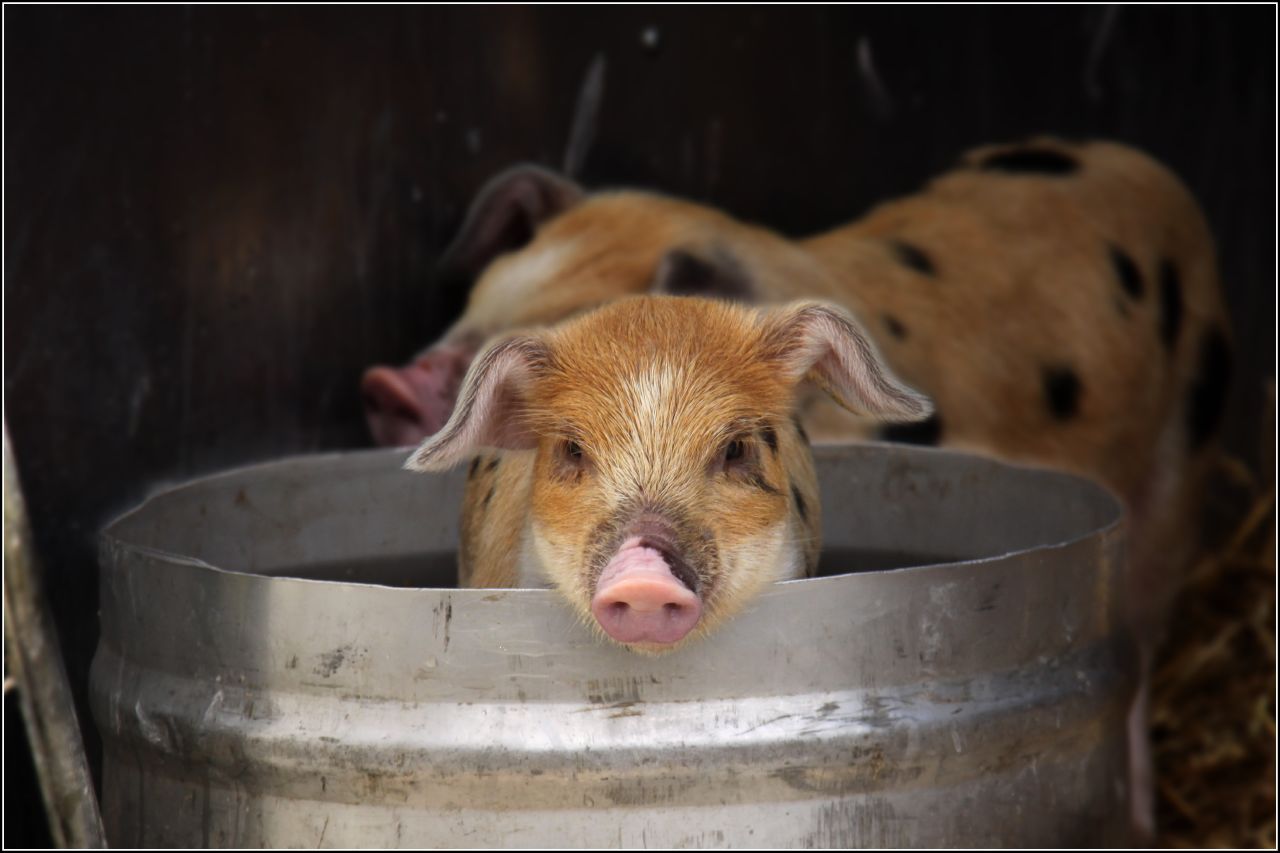
This is a pig in a bucket. Hopefully it makes the article look more interesting by being cute.

However, one word which I must begrudgingly admit is an auto-antonym is 'literally', a word that is the source of constant confusion due to its overuse. The Oxford English Dictionary now lists 'literally' as either meaning 'exactly true' or 'emphasised, but not actually true'. It's almost upsetting to think that when someone uses the word 'literally' to emphasise something, they're technically still using the word correctly, but hey, that's the evolution of language.

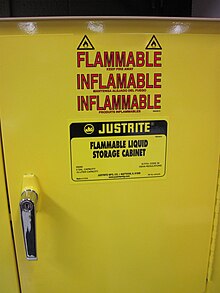
To finish, let's go for a word that could actually cause some confusion. 'Inflammable' is a common enough word that is commonly enough believed to mean 'incapable of burning'. This makes perfect sense, 'flammable' refers to something that can be set alight, and the prefix 'in-' tends to denote the opposite of something. However, this meaning is, conventionally, incorrect. The prefix 'in-' here is actually from the word 'inflame', meaning that 'inflammable' actually means 'something that can be inflamed', the exact opposite of what we would think it to mean! As William Strunk and E.B. White note in their 1979 style guide 'The Elements of Style' "some people are thrown off by the in- and think inflammable means "not combustible." For this reason, trucks carrying gasoline or explosives are now marked FLAMMABLE. Unless you are operating such a truck and hence are concerned with the safety of children and illiterates, use inflammable."


Perhaps Strunk and White are too harsh in their assessment of those who are unaware of the 'true' meaning of 'inflammable', but here they've very handily pointed out one reason why you should maybe care about auto-antonyms. Personally, I just like them as an oddity of language, To close this far too long editorial on words that nobody really cares about, here's a list of auto-antonyms for you to think about, or not, I'm not the boss of you.

Dust, Clip, Left, Trim, Pretty, Quite, Seed, Off.

I'd also love to hear from you if you have any more auto-antonyms to add to the list; mine is by no means comprehensive. Thanks for your time if you've read this far, and I'll be back soon to talk about something else, probably something a bit less niche.